Hi Reader,
There is a question that comes up in briefing rooms and flying club bars in equal measure: does a student pilot really need to learn the old ways? Steam gauges, the whiz wheel, dead reckoning with a pencil and a paper chart. When a Garmin G1000 can do it all in a glance, why bother? The honest answer is more interesting than either side usually admits.
The cockpit has never been more capable, or more capable of hiding what you don't know.
Glass cockpit systems, dominated today by Garmin's G1000 and its successors, have fundamentally changed how pilots interact with an aeroplane. The primary flight display folds attitude, airspeed, altitude, heading, and vertical speed into a single integrated screen. The multi-function display layers on navigation, engine data, terrain, traffic, and weather. Information that once required a trained eye scanning six separate round dials now sits in one place, colour-coded, annotated, and cross-checked automatically.
For situational awareness, especially in busy airspace or poor conditions, this is a genuine advance. The workload reduction is real. The integration is elegant. And airlines know it: many now favour applicants who have trained on glass because the cognitive jump to a modern flight deck is smaller.
But there is something glass does not teach, and it shows up at the worst moments. When the screen dims, the GPS drops out, or the automation enters a mode the pilot didn't select and doesn't understand, the question becomes whether there is anything underneath the digital fluency. A pilot who has spent their entire training life staring at a PFD may struggle to interpret a standby altimeter, run a wind triangle on a whiz wheel, or hold a heading without the magenta line telling them where to go.
Research backs this up. A study tracking trainee pilots through the transition from analogue to glass found consistently poorer performance among those who started on glass, at least initially. The round-dial world forces a discipline that glass can mask: a continuous scan, an active mental model of what the aircraft is doing, a direct feel for the relationship between inputs and outcomes.
The E6B tells the same story. The mechanical flight computer, unchanged in its essentials since World War II, is still required for many licence examinations on both sides of the Atlantic. Not because regulators are nostalgic, but because working through a wind triangle or a fuel calculation by hand requires the pilot to understand the problem, not just its answer. Digital E6Bs and apps are faster. They are also better at hiding a wrong assumption.
The case for teaching both is not sentimental. It is practical. Most training fleets today are mixed, some aircraft with steam gauges, some with glass, some with hybrid panels that combine both. The pilot who can only work one system is already less capable than the pilot who can work either. And when technology fails, which it does, the pilot who genuinely understands what they are looking at is the one who gets everyone home.
Learn the fundamentals first. Then let the glass make you faster.
|
|
Pilot Institute Airplane Courses
Their pilot training school will help you achieve your airplane flying dreams. Getting a pilot license is not easy, but it’s easier than ever before with their free and paid online classes
|
Glass cockpit adoption accelerating in GA fleets
Almost all new production general aviation aircraft now ship with glass cockpit avionics as standard, with older aircraft increasingly being retrofitted. The result is a mixed fleet across most flight schools, where students may fly three different cockpit configurations within the same training programme. Instructors are increasingly expected to be fluent in all of them.
The E6B is not going away
Despite the dominance of apps like ForeFlight and Garmin Pilot, the mechanical E6B remains a required tool for many pilot licensing examinations, including the FAA private pilot knowledge test, where candidates are not permitted to bring mobile phones or programmable devices. Many examiners also expect students to use manual calculation tools during checkrides. The whiz wheel, invented in the 1930s, is still earning its place in the flight bag.
Automation dependency is a growing training concern
Aviation educators are paying increasing attention to what happens when students who have trained primarily on glass encounter failures or unusual situations. Mode confusion, where a pilot loses track of what the autopilot or GPS is doing, is consistently cited as one of the most common errors in glass cockpit operations. The antidote, according to most instructors, is deliberate manual flying practice built into training from the beginning, not bolted on at the end.
Hybrid cockpits offer a middle path
Many training aircraft now feature panels that combine traditional analogue flight instruments with modern digital navigation displays. This configuration exposes students to both worlds simultaneously and is increasingly seen as an effective way to build solid fundamentals without leaving students unprepared for modern avionics. Several major flight academies have structured their fleets specifically around this hybrid approach.
If you are a student pilot staring at a whiz wheel wondering what century you have landed in, you are not alone. Every pilot who has been through training has had that moment. Here is the thing: the E6B is not there to torture you. It is there to make you think through a problem rather than hand it to an app. The pilots who come out of training genuinely understanding the numbers, not just reading them off a screen, tend to be the ones who stay calm when something unexpected happens. The tools change. The thinking does not.
Whether you trained on steam gauges in a battered Cessna 150 or went straight into a G1000-equipped Diamond, the Student Pilot Community is a place for all of it. Come and share your experience in the group, 69,000 members and counting. See you next week.
Exclusive Discounts and Recommendations |
- Rod Machado's 40-hour Private Pilot eLearning Ground School.
Apply discount code BEN15%OFF at checkout for 15% off!
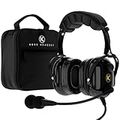
- Kore Aviation Headsets.
Apply the discount code BEN10 at checkout for 10% off!
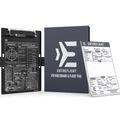
- Flight Outfitters - Pilot Gear, Apparel, Kneeboards
Apply discount code BEN5 at checkout for 5% off!
- How To Gain a Private Pilot License (Course)
"Superb structure, easy to follow and great visuals!" ~ Elina
- Aviation Career Guides
Your roadmaps to a career in aviation job roles
|
Widen Your Horizons
|
💡 Today You Should Know
Learn something new every Friday. Join 2,000+ nerds and satisfy your curiosity one question at a time with topics including science, technology, history, and more. |
|
|
Affiliate Disclosure
Affiliate disclosure: Some links shared may earn a small commission at no extra cost to you. We only share resources and products that we believe are genuinely helpful.
|